


Line betting is something most Australians come across pretty quickly once they start looking beyond basic win or lose bets. You see a number next to a team, sometimes with a plus or minus in front of it, and it is not immediately obvious what you are supposed to do with that information.
The easiest way to think about line betting is that it is not really about who wins the game. It is about how close the game ends up being. The line is just a way of adjusting the score before the match starts so both teams sit on more even footing for betting purposes.
This makes a lot of sense in Australian sport. In AFL and NRL, there are plenty of matches where one side is clearly stronger on paper. Head-to-head betting in those games can feel pretty pointless, because the result itself is rarely in doubt. Line betting exists to add context to those matchups by focusing on the margin instead of the winner.
What follows is a straightforward breakdown of how line betting works and what those numbers actually mean, using real AFL and NRL style examples. Nothing fancy, no selling, just enough explanation so the next time you see a line market, it feels familiar rather than confusing.
What Is Line Betting?
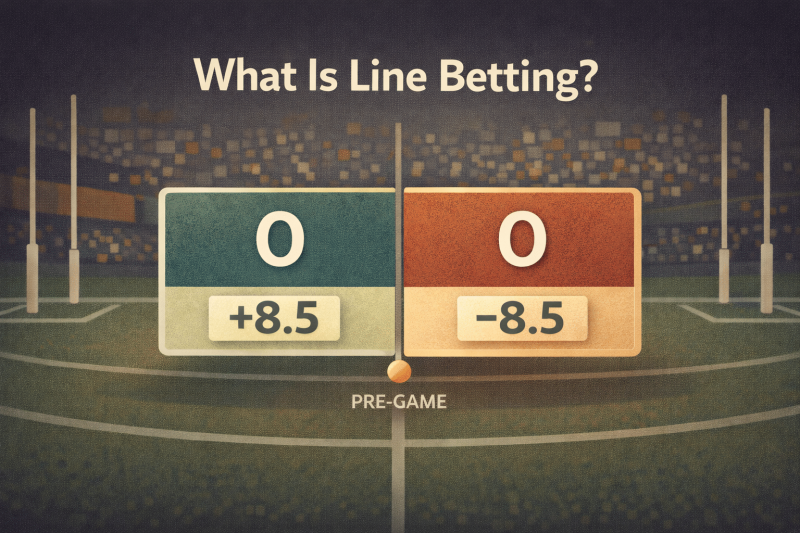
Line betting is basically a way of putting a handicap on a game before it starts. One team begins with points added to their score, the other starts behind, and the bet is decided after those points are taken into account.
The reason it exists is pretty simple. Not every match is a fair contest. When one side is clearly better, just betting on who wins does not always feel very meaningful. The line is there to close that gap and make both sides of the bet more evenly matched.
When you look at a line market at top betting sites, you will see a number next to each team. A minus number usually belongs to the favourite. That team needs to win by more than that margin for the bet to get up. A plus number belongs to the underdog, and it gives them some breathing room if they lose.
This is where line betting starts to feel different to head to head betting. The final result still matters, but it is not the whole story. A team can win the game and still let you down if the margin is too small. On the flip side, a team can lose and still be the right pick if they keep things close.
Once you get your head around that idea, line betting becomes much easier to read. You stop asking who is going to win and start thinking about how the game is actually likely to unfold.
What Does the Line Mean in Betting?
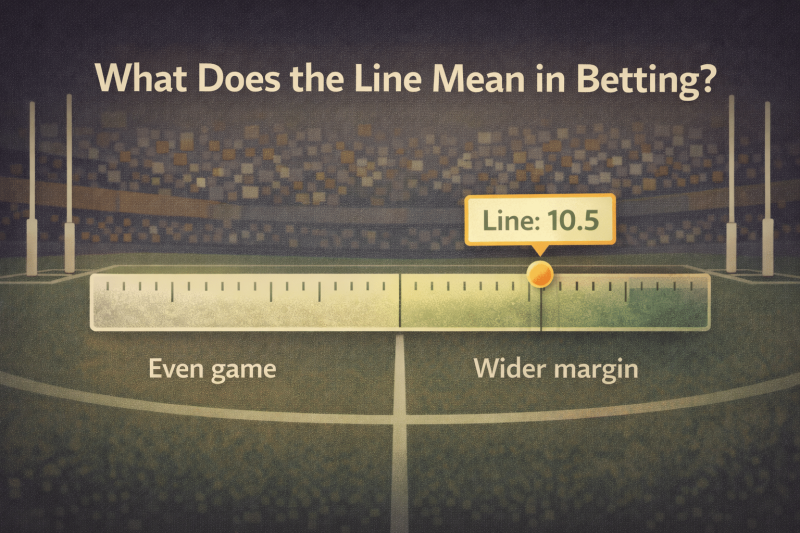
Before getting into examples, it helps to understand what the line is actually trying to tell you. At first glance it can look like just another number on the screen, but once you know how to read it, the line gives you a quick snapshot of how close or one sided a game is expected to be.
The Line Is About the Margin
The line is simply a number that represents the expected margin in a game. It is not a prediction of the exact score, and it is not a judgement on which team is better. It is just a reference point for how far apart the two teams are expected to be.
When you see a line like -10.5 next to one team and +10.5 next to the other, those numbers are connected. One team is being asked to win by more than ten points, while the other is being given a ten point buffer.
Plus and Minus Explained
The plus and minus signs tell you which role each team is playing. A minus usually means the team is the favourite. They need to win by more than the listed margin for the bet to work out. A plus means the team is the underdog and can lose, as long as the margin stays within that number.
Once you start focusing on the sign rather than just the number, the line becomes much easier to read at a glance.
Why Half Points Are Used
You will notice that most lines include a half point, like 4.5 or 14.5. This is done to avoid a dead heat. The half point forces a result one way or the other, so the bet does not end in a tie.
Can the Line Change?
The line reflects how a game is expected to play out at a given time. As team news comes out or conditions change, that number can move. The purpose of the line stays the same, though. It always comes back to the margin, not simply who wins the match.
How Does Line Betting Work?
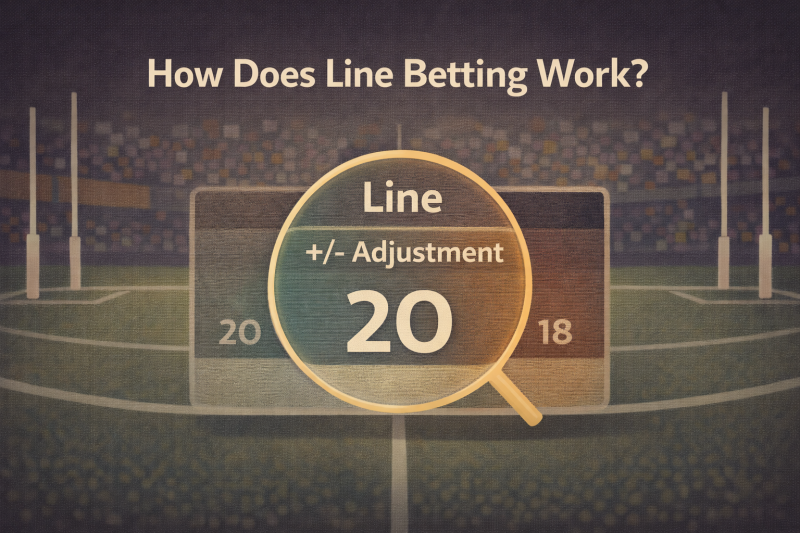
Once the game is over, a line bet is settled by adjusting the final score using the line and then seeing which side comes out on top. Nothing else changes. The match still finishes with the same score, but for betting purposes, that score is looked at through the lens of the handicap.
If you backed the favourite, the line is subtracted from their final score. If you backed the underdog, the line is added to theirs. After that adjustment is made, whichever team has the higher adjusted score is the winner of the bet.
This is why people often say line betting is settled after the fact. You are not trying to guess a special outcome during the game. You are simply waiting to see how the margin lands once the line is applied.
It also explains why line betting can feel confusing at first. You can watch your team win the match, feel like you made the right call, and then realise the margin was not quite enough. At the same time, you can sit through a loss knowing the bet is still alive if the score stays close.
The key thing to remember is that the line is always applied to the final result, not during play and not to individual moments. Once you get comfortable with that idea, the way line bets are settled starts to feel very straightforward.
Line Betting Explained Using AFL Examples

AFL is one of the clearest sports for understanding line betting because margins play such a big role in how games are decided. Blowouts are common, momentum can swing quickly, and a team winning the match does not always tell you much about how dominant they actually were.
A Typical AFL Line Setup
In AFL, lines are often larger than in other sports because of the scoring system. It is normal to see favourites listed with double digit handicaps, particularly when strong teams are playing lower ranked sides.
For example, imagine Melbourne are playing West Coast. Melbourne are clear favourites, so the line is set at Melbourne -16.5, with West Coast at +16.5.
That line is asking Melbourne to win by just under three goals. At the same time, it gives West Coast a reasonable buffer if they can stay competitive for most of the match.
How the Bet Is Decided
If you back Melbourne at -16.5, they need to win the game by at least 17 points for the bet to win. Anything less than that and the bet loses, even if Melbourne still win the match.
If you back West Coast at +16.5, they can lose by up to 16 points and the bet still wins. A closer loss, or an outright win, both result in a winning line bet.
Now imagine Melbourne win the match by 14 points.
On the scoreboard, Melbourne have won. Once the line is applied, they fall short. Melbourne -16.5 loses, while West Coast +16.5 wins.
Why Margins Matter So Much in AFL
This is where line betting really comes into its own in AFL. A few goals late in a quarter, a team easing off with the result secured, or a burst of momentum can all change the margin without changing the winner.
Because of that, line betting in AFL often comes down to how consistently a team performs across four quarters, not just whether they are the better side. It rewards thinking about game flow, not just tipping the team you expect to win.
Line Betting Explained Using NRL Examples

Line betting works the same way in NRL as it does in AFL, but it usually feels tighter. Games are lower scoring, margins stay smaller, and that means the line can come down to a single moment.
A Typical NRL Line Setup
In most NRL games, the line is not huge. Four, six, maybe eight points is pretty common, especially when the teams are fairly close.
Say the Brisbane Broncos are playing the Gold Coast Titans. Brisbane are favourites, but it is not a mismatch, so the line comes out at Brisbane -6.5 and Gold Coast +6.5.
That number is basically saying Brisbane need to do more than just win. They need to clear a converted try. On the other side, Gold Coast are being given enough room that they do not have to be perfect, just competitive.
How the Bet Is Decided
If you are on Brisbane at -6.5, they need to win by seven or more. Winning by six is not enough, even though it still goes down as a win in the standings.
If you are on Gold Coast at +6.5, a close loss works fine. A win works too.
Now imagine Brisbane win 20 to 16.
On paper, they have done the job. From a line point of view, they have not quite done enough. Brisbane miss the number, Gold Coast scrape home.
Why NRL Line Betting Feels Tighter
This is the part that catches people out. In NRL, one late try can undo an entire night. A missed conversion, a penalty goal, even a soft try at the end can flip a line bet that looked safe for seventy minutes.
There just are not that many scoring chances to play with. So every point counts.
That is why line betting in NRL often suits people who watch how a game unfolds rather than just who is on top. Close games, defensive sets, teams protecting a lead. Those are the matches where the line usually ends up telling the real story.
Why Line Betting Is Popular in Australia
Line betting has taken off here mostly because it fits the way people already watch and talk about footy. It doesn’t really feel like a separate way of betting once you get used to it. It just lines up with how games are judged in the first place.
1) It Gives Obvious Games Something Else to Think About
Plenty of matches feel decided before the first bounce. You look at the teams and you already know who should win. Line betting changes the focus from the result to the performance. The question becomes whether the better side actually puts the game to bed or just does enough to scrape through.
2) It Makes Backing Weaker Teams Feel More Realistic
Backing an underdog outright usually means hoping for chaos. Line betting lowers that bar. You’re not asking for a miracle, just effort and discipline. In AFL and NRL especially, teams lose games every week while still staying competitive on the scoreboard.
3) Margins Are How Footy Is Judged Anyway
After most games, the first thing people mention is the margin. Was it convincing, did they ease off late, did the score flatter one side. Line betting is built around those same ideas, which is why it doesn’t feel unnatural once you understand it.
4) It Suits People Who Follow the Game Closely
Line betting tends to appeal to fans who pay attention to how games unfold, not just who wins. Momentum swings, late goals, teams protecting a lead, all of that matters. If you already think about footy that way, betting the line feels like a natural extension of it.
Common Line Betting Mistakes
Line betting is not complicated once it clicks, but there are a few mistakes that catch people out again and again. Most of them come down to thinking about the game the wrong way.
Assuming a Win Means a Winning Bet
This is the big one. Someone backs a team, watches them win, and then wonders why the bet didn’t land. With line betting, the result and the margin are two different things. If the favourite doesn’t win by enough, it doesn’t matter that they still got the four points.
This usually only happens once or twice before it sinks in, but it’s where most confusion starts.
Ignoring the Number and Backing the Team
It’s easy to focus on the team name and forget about the line itself. People will say they like a side and lock it in without really thinking about whether the margin makes sense.
With line betting, the number matters just as much as the team. Sometimes more. A strong side can still be a bad line bet if the handicap is doing most of the heavy lifting.
Treating AFL and NRL the Same
Margins behave very differently across sports. AFL can swing by five or six goals in a short space of time. NRL often can’t. A line that feels small in AFL can be massive in NRL.
People who copy the same thinking across both codes tend to get caught out, especially in tighter NRL games.
Forgetting About Late Changes
Line betting is all about how a game plays out. Late outs, injuries, or changes in conditions can have a bigger impact on the margin than on the result itself.
A team might still win without a key player, but covering a line becomes much harder. That’s something people often realise after the fact.
Line Betting vs Head-to-head
Most people don’t consciously choose between these two markets. They just drift toward one because it feels more comfortable. Usually that’s head-to-head, at least at the start.
What Head-to-head Betting Is
Head-to-head is basically saying, “I think this team wins.” That’s it.
You don’t really think about the score too much. If they get home by a point or blow the other side off the park, it makes no difference. A win is a win.
That’s why it feels familiar. It matches how you watch the game.
What Line Betting Changes
Line betting nudges you into thinking a bit differently. You’re still picking a side, but now you’re also thinking about how the game actually plays out.
Does the favourite really put it away? Do they get out to a lead and then coast? Does the underdog hang around longer than people expect?
You’re not just asking who’s better. You’re asking what kind of game it’s going to be.
Why a Team Can Win and Still Be the Wrong Bet
This is usually where people get caught out.
A team wins, you feel good about the pick, then you realise the margin wasn’t there. Nothing went wrong during the game. The bet just needed more than the result.
Once you see that happen a couple of times, it stops feeling strange. You start separating the game itself from how the bet is graded.
Which One Makes More Sense
Some people never move past head-to-head, and that’s fine. Others slowly stop using it as much once margins start standing out more than winners.
If you already find yourself talking about whether a team really deserved the win, or whether the score flattered someone, line betting usually makes sense pretty quickly.
A Final Word on Line Betting
Line betting sounds more complicated than it really is. Once you realise it’s just about the margin, not the winner, most of the confusion drops away.
In AFL and NRL especially, that way of looking at a game often feels more natural anyway. We already talk about whether a win was convincing or whether a team just scraped by.
You don’t have to use line betting all the time. It’s just another way of reading a matchup, and once you understand it, it stops feeling like something you need to avoid or overthink.
Line Betting FAQs
Can a line bet end in a draw?
Most of the time, no. That’s because lines are usually set with a half point, like 6.5 or 14.5, which forces a result either way.
Occasionally you’ll see a whole number line. In those cases, a draw is possible. If the final margin lands exactly on the line, the bet is usually settled as a push, meaning your stake is returned. What happens can vary slightly depending on the rules, but it’s not something you see very often.
Is line betting the same as handicap betting?
Yes. They’re the same thing.
“Line” is just the term most commonly used in Australia, especially for AFL and NRL. Handicap betting is the more general name for the idea of giving one team a head start and asking the other to overcome it.
If you understand one, you understand the other.
Does the line change before a game starts?
It can. Lines are based on how a game is expected to play out at a given point in time. If team news changes, conditions shift, or a matchup starts getting read differently, the number can move.
The important thing is that the purpose of the line stays the same. It’s always about setting a margin that reflects how close the game is expected to be, not predicting the final score.
Is line betting harder than head-to-head?
It can feel that way at first, mostly because it adds another layer to think about.
With head-to-head, you’re only worried about the winner. With line betting, you’re thinking about how the game unfolds, whether a lead is extended, and how late moments affect the margin.
Once you get used to watching games that way, it often stops feeling harder and just feels different.
Do all sports use line betting?
Not all, but many do.
Line betting works best in sports where margins matter and scoring is predictable enough to set a handicap. That’s why it’s so common in AFL and NRL, and less common in sports where results don’t spread out the same way.